14 July 2009

What.Were.You.Thinking?

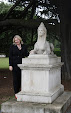
My own Uncle Mame offered to pick up my latest impulse auction buy on his way out East and this was the bone-chilling message that brought me his verdict. And the death knell - don't wince - the black leather upholstery turned out to be Naugahyde.

I always impress the importance of inspecting items firsthand to clients and friends, but when it comes to my own buying at auction, I throw the dice a bit too wantonly - but, c'mon, am I really going to fly out to Detroit or East Dennis (where? you ask, proving my point exactly). Like a guest on Oprah, if my example helps but one person....

Yet I'm still hopeful the fender will work out (naugahyde replaced, of course). Even though my uncle's taste is pretty much flawless, perhaps in situ it will metamorphose into a swan. Stay tuned....

Wasp Chic, Circa 1989

House and Garden profiled this Sutton Place aerie in 1989 whose owner - in true WASP fashion - wanted to remain anonymous. It featured an outstanding art collection (which merited Picasso biographer John Richardson writing the feature) and decoration by Sister Parish who had known the client for decades. My Design Deepthroat revealed the owner as Betsey Whitney, one of the famed Cushing sisters who all made spectacular marriages (if your idea of spectacular is a great fortune and gilded name).

Sisters Babe Mortimer Paley, Betsey Roosevelt Whitney, and Minnie Astor Fosburgh,
from left to right, were the subject of this biography


After her husband Jock's death, Betsey downsized from a townhouse into this apartment leaving Mrs. Parish with a surfeit of delectable furnishings from which to choose. Richardson recounts how Sister would strike terror in the hearts of new clients when she would wheel a tea trolley through their home, piling on all the belongings she deemed eyesores - rest assured, Betsey was NEVER one of those.

Although Mrs. Parish was not averse to layering as attested to by these rooms in which every surface is covered with silver picture frames, fresh flowers (grown in her Long Island greenhouses, natch), and other bibelots, there is something about the full-blown clutter that epitomizes the excess of the '80s.

It is also interesting that the museum-quality art didn't dictate a conformingly sterile treatment, but instead enhanced the cozy and comfortable surroundings. Downplaying the importance of the collection goes hand-in-hand with the WASP abhorrence of flash and attention-seeking.

Over the black lacquer open shelves is Monet's Camille on the Beach, Trouville, a portrait of the artist's wife painted while on honeymoon, and which now hangs at the Yale University Art Gallery. Don't miss the interesting passementerie on the back of the side chairs....

Richardson recounts how Mrs. Whitney served the most incredible miniature vegetables - such as lima beans "the size of seed pearls", also grown on her country estate, and suggests this might have been the inspiration behind Truman Capote's declaration of "tiny vegetables [as] the acme of old-world luxe." Perhaps, but the feud between her sister Babe and Gloria Guinness over who could produce the tiniest vegetables was legendary.

I have to say I'm not loving how this napkin was folded in combination with the en suite placemat. However who can deny how gorgeous the embroidery (hand-done no doubt) of the linens. Perhaps it's by Marghab from Madeira, Portugal, reputed for its exquisite quality....

....and currently my favorite Ebay search term which uncovered this pristine set of 8 "Tropical Fish" cocktail napkins, an easy and affordable way to bring the genteel and civilized into one's home today.

Photos 1, 3-7 by William Waldron for House and Garden, in the October 1989 issue

10 July 2009

"Natura Morta": A New Take on Old Masters

Look carefully - very carefully. This is not a seventeenth century Old Master still-life, but a vignette meticulously and exquisitely conceived, realized and photographed by Paulette Tavormina.

I had the pleasure of sitting down with Paulette - who is as glamorous (think Rita Hayworth) as she is talented - and heard the fascinating story of how all her diverse interests and experiences have beautifully coalesced into her stunning "Natura Morta" series.

One of Paulette's newest works: strawberries were meant to evoke earthly paradise

With an early love of art history and an appreciation for objects (I think you are either a person who connects to "things" and imbues them with emotion and memory - or you're not), Paulette began her career in commercial photography and soon specialized in styling and shooting food for cookbooks. This led to creating food scenes and props for films. (That steak Anthony Hopkins ate in Nixon with bloody juice seeping out is Paulette's handiwork). To complete the circle of photography to food to art, Paulette has spent the past few years capturing the most rare masterpieces in the world with her lens for Sotheby's auctioneers.

Every item in these photographs is hand-selected by Paulette: shells from the beach, the perfect carrots at the market, dead bugs on windowsills (like Wolfgang Peterson who directed The Perfect Storm, another Paulette project, no creatures are killed in the making of her pictures).

Although a few of her works are directly inspired by Old Master greats, such as her Lemons and Peony...


which was inspired by this Francisco de Zurbarán, circa 1633, in the Norton Simon, Pasadena, CA
or the watery colors and composition of this arrangement


which were chosen in homage to the ethereal works of one of the first female still-life painters Giovanna Garzoni who worked with tempera on vellum

A Dish of Broad Beans, c. 1640s

....most of her still-lifes evolve organically and come from her own mind's eye.

The genre of still-life painting flourished in the seventeenth century, and served equally as a record of the fleeting nature of earthly pleasures as well as a depiction of wealth, with costly and exotic fruits and objects testifying to the success and sophistication of its owner. Laden with symbolism, the appearance of figs denoted well-being and prosperity, pears stood in for Venus and love, and so on. To delve deeper, Paulette recommends Nature and Its Symbols by Lucia Impelluso and Stephen Sartarelli. The Magic of Things: Still Painting 1500 - 1800 is a lushly illustrated volume that she also returns to again and again, as are the Four Seasons, a series of paintings by Giuseppe Arcimboldo, her first stop at the Louvre.

Summer by Arcimboldo

Paulette's work is accessibly priced and with her first show opening on September 17 at the Robert Klein Gallery in Boston this fall, this is a good time to start collecting her.

Prints are 8" x 10" and 16" x 20", although larger ones can be commissioned.
Signed and numbered limited edition ink jet prints are available through the Robert Klein Gallery.

To see the entire Natura Morta series, go to Paulette's website: http://www.tavorminaphotography.com/

09 July 2009

Bonjour, Chicsetera

"Bon voyage" to my friend D'arcy whose site chicsetera launched this week! Smooth sailing is on the charts for what will undoubtedly be a succès fou.

Chicsetera is an insider's resource for all things stylish and branché in Paris and there is no better guide than Ms. D'arcy who is a fiend for fashion with an incredible nose for the next big thing.

D'arcy and I met years ago in Paris where we were jeune filles au pair by day (and dancing queens by night - it took us months, but we finely broke through the velvet ropes of Regine's with the Billy Jean dance floor and the ultra-exclusive Castel). We spent our free time roaming the streets of the left and right banks and loved nothing more than to lèche-vitrine and critique our favorite couture creations that were out of our reach behind glass walls. Tom Ford for Gucci (with Carine Roitfeld's styling), Alber Elbaz for Guy Laroche (we knew way back then what a star he was), the mysterious Martin Margiela.... such is the fantasy of fashion that Vogue can be just as filling as a five course meal at a Michelin three starred resto.

Click here to subscribe.

07 July 2009

Les Tétons au jardin

Yes, these bushes are meant to look exactly like you think they look. In fact, Titus and Frederic, the caretakers of our communal earthly paradise, have spent two diligent and focused years to achieve this result - and why not? Many artists have replicated the human form in the search of beauty....

A Sèvres porcelain bowl from Marie-Antoinette's laiterie at Rambouillet is said to have been molded from the Queen's own breast. Click here to order the reproduction made by Bernardaud.

Many say that the size and shape of the champagne coupe was inspired by the breast of such famous lovelies as Helen of Troy and the Marquise de Pompadour. Dancers at the Moulin Rouge, such as the infamous La Goulue below photographed by Adolphe Block, were rumoured to have had their anatomy measured by the coupe as part of their audition process.

If they filled the cup, perfect... if the cup runneth over, next!


This painting at the Louvre is attributed to the Fontainbleau school and is thought to be of Gabrielle d'Estrees and one of her sisters in a wooden bathtub, c. 1595. Gabrielle d'Estrees was the mistress of Henry IV and is depicted holding a ring given to her by the king. Her sister pinches her nipple to indicate that she is pregnant with the king's child. In the background a female figure is sewing clothes for the baby.