17 June 2011

Greetings from London!


Come read about my London adventures, including a visit to David Hicks' country house The Grove, over on New York Social Diary here...

04 June 2011

The French Neo-Classicist: Michael Simon

A boudoir by Michael Simon at the Kip's Bay Showhouse

America's Dean of Decorating Billy Baldwin famously wrote about FFF and FFV: Fine French Furniture and the First Families of Virginia - both of which summed up the high style many aspired to in the 1950's and '60's.  Whether it was Jansen for Jayne Wrightsman or McMillen for the Fords, a formal French salon was de rigueur for society's luminaries. 

 This Louis XVI room is from the Hotel Cabris and currently installed in the Metropolitan Museum's Wrightsman Galleries.  The two armchairs against the wall are part of the same suite as the canape seen in the next photo.

Today,  FFF and FFV have largely been supplanted by "eclectic" and hedge fund managers.  However, there are those who still crave a correct boiseried room, and whether they are a Russian oligarch or a Saudi sheik, they know to turn to New York interior designer Michael Simon

 The canape was formerly owned by Enid Haupt whose legendary Park Avenue penthouse was decorated by Parish Hadley.  Simon recovered it in this canary yellow Adam document silk that features ostriches.  In the same room, he covered a chair in ostrich-skin - just one example of Simon's thoughtful relationships.

 From a millimeter of a molding's profile to the gimp on a veilleuse, Simon is a master.

To properly appreciate Simon's keen eye and impeccable taste, click over to the June 7 Christie's New York 500 Years sale  which features over 30 items from his collection.  Just yesterday, Michael gave me a personal tour and, as with all lovers of objects, made each come alive for me with personal stories.

One of my favorites was about this canape a la turque which he purchased from the Antenor Patino sale.  While bidding, he was sitting next to House and Garden editor Cynthia Frank and opined that he would have to have it hoisted up into his building.  Frank called him up the next day to see if H&G could shoot this asap, and Simon said sure, but they would have to wait for it to be re-upholstered.  Await they couldn't, and they had the sofa hoisted and hoisted down all in the same day for this iconic shot below:


Only in New York!


I asked why he had chosen the milk chocolate velvet for recovering, and he replied that the form of the piece was so expressive and sculptural, he wanted something quiet to let it speak.  Michael pointed out that the original iron strap used to support the back, as seen above, was still intact.

 Lot 227: A pair of 19th century French ormolu candlesticks mounted as lamps

Another quiet detail was the anthracite grey (Simon's signature color) silk velvet lampshades (lined in gold foil, natch) on a pair of ormolu candlesticks he converted into lamps.  He had the finial made to complement the base.


 Lot 228: A PAIR OF FRENCH ORMOLU-MOUNTED GREEN CRACKLE-GLAZED PORCELAIN DOUBLE-GOURD VASES

I was drawn to this pair of quirky ormolu-mounted porcelain vases.  While the craquelure and double-gourd shape would suggest Chinese manufacture, they were actually made in France to imitate Chinese wares.  The mounts also are surprising - while the goats are more typical of le gout grec, they are in the rococo style.

  
 Lot 220: A RUSSIAN ORMOLU, CLEAR AND AMETHYST CUT-GLASS LANTERN,CIRCA 1790

I've never gotten that excited over chandeliers - until now!  The centerpiece of Simon's collection is a magnificent Louis XVI rock-crystal  chandelier, which you will have to go to Christie's to see for yourself.  Instead, I'm showing you this little Russian jewel - I love the diamond-shaped ormolu chains cascading down haphazardly and the pendants' tiny amethyst cut glass beads alternating with clear ones. 

All of these items are a pleasure to behold.  Run to Christie's while you can and also catch the preview of the contents of a Mark Hampton Park Avenue project - it's pure '80s opulence.

And just in case Mr. EEE is reading... I'd be very happy with these tole cache-pots.  Just think of all the money we'd save not having to replace real flowers!


13 May 2011

Classicism and the City: Chez Fairfax and Sammons


This Spring a house very dear to my heart is celebrating its 75th year anniversary as a museum.  The Merchant's House Museum is New York City's only historic residence with its interiors preserved and landmarked.  What is even more astonishing is how many people don't know about this Greek Revival beauty nestled in the East Village - luckily, those who do are passionate about it, not least of all Anne Fairfax and Richard Sammons.

Anne and Richard are ardent champions of Classical architecture, and as their 2006 monograph attests, elegant and expert practitioners as well.  It is no surprise that their own space is as delightful and unusual as any to be found in the city.  They purchased the red brick carriage house-studio in 2000 from the estate of business tycoon Armand Hammer, who had owned it ever since his university days.

One enters the house through a small entry way lacquered in a pulse-racing crimson hung with a myriad of small convex mirrors a la John Soane.


Directly onwards is the beadboard-paneled kitchen-cum-sitting room complete with a cosy Delft-tiled fireplace. 


Richard is a sailing enthusiast, and the ingenious built-in storage seems reminiscent of a ship (although apparently this passion unfolded after the kitchen was designed).


A staircase takes one up to the bedroom...


...which was made smaller by the addition of a walk-in closet. 


Richard and Anne definitely have their priorities right, as far as I'm concerned!

While the outside facade is perfectly proportioned, the double-height studio, complete with skylight, was a tricky wedge shape, a design challenge that the couple solved with elan.

Just as their coral silk velvet sofa inspired me to recover mine similarly, I will be taking another page out their upholstery book with these summer slipcovers of white duck piped in black...


One corner of the room was carved out for this deeply chic black bar.  The space cries out for parties, and the bar is regularly pressed into service.

 Anne in black velvet in her swell-egant bar

A mezzanine catwalk was built around the perimeter of the room and to give the room a more regular shape, an exedra was created on the facade wall opposed by this open arch leading out to the back terrace.

A snappy striped awning covers the outdoor space so that it is bone-dry all year round.  Another bar is often set up here when Anne and Richard throw larger bashes.  Today, a craftsman was using it to make a dinghy.


A bust of Diane presides over the Lutyens-influenced mantel and serves as muse to the many artists and architects who continue to gather here, and, undoubtedly, find inspiration. 


Many thanks to Anne and Richard for letting me share this glimpse.  Click here to see more courtesy of New York Social Diary.

03 May 2011

Patriotism and Patina at the Spring Show NYC

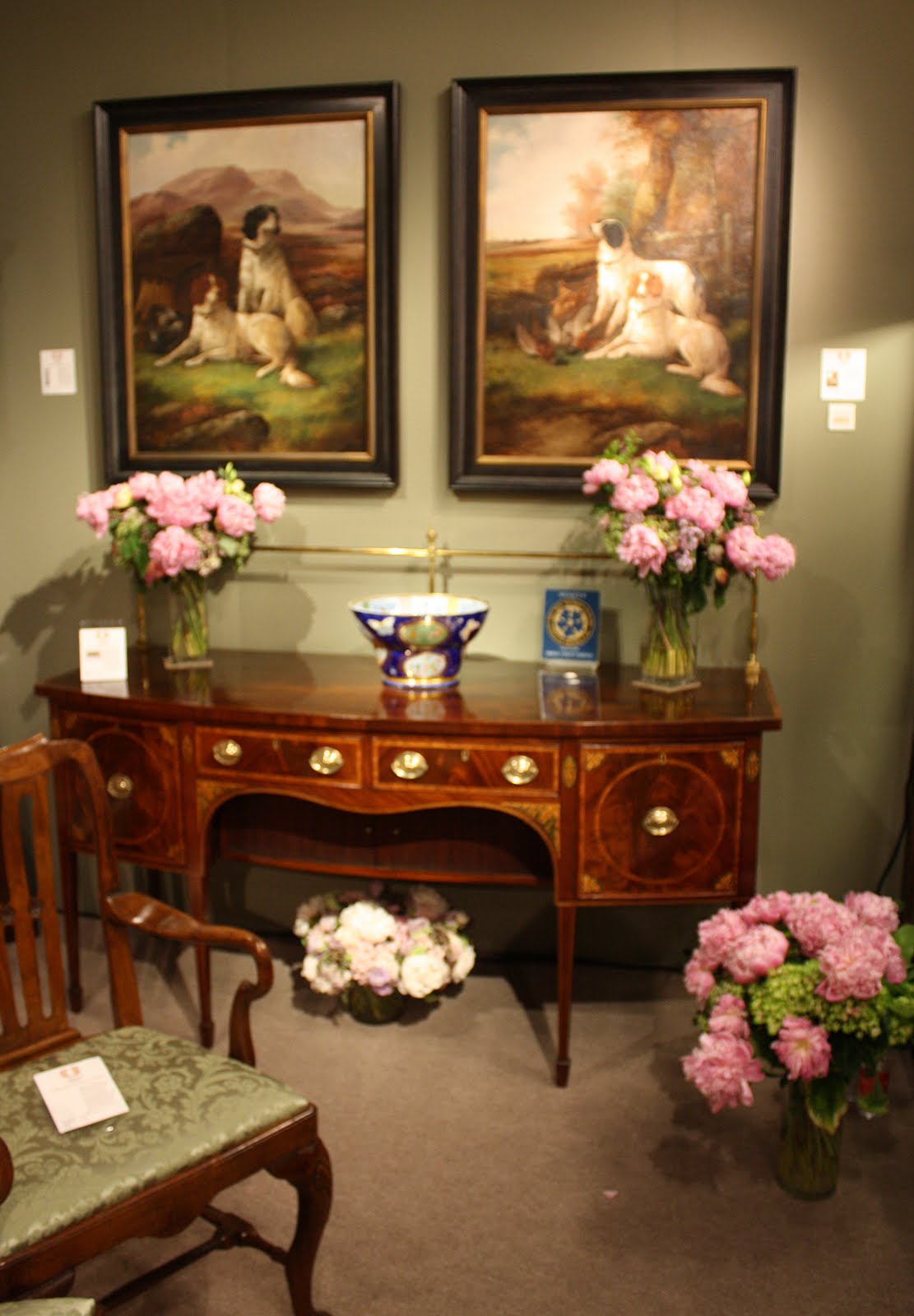
 Potted orchids and flags at Robert Simon Fine Art

Yesterday was the final day of the first-ever Spring Show NYC.  If you missed it, don't worry - it will definitely be back next year.  While there are many antiques shows already crowding up the calendar, this one stands out as fresh, eclectic, and, importantly, as it is a vetted show, everything is exactly what it is supposed to be.

Swedish design dynamo Lars Bolander was called in to apply his flair to the show's floor, which included yellow and white zebra-cotton slip-covered banquettes and 6' tall painted obelisks parading down the aisles.

Bolander's carnelian red center table and over-scaled Gothic style armchair greeted entrants to the show.

As much inspiration could be found in the dealers' display of objects as in the objects themselves.

Collier Gwin of Foster-Gwin earned raves from New York Times' art critic Roberta Smith for his coupling of abstract art with his stock of fine Continental antiques...

as seen in this dynamic pairing of "The Houston Scene" painted by Hassel Smith in 1959 hung over 18th century Italian Neoclassical painted console tables with fanciful trompe-l'oeil porphyry tops.


Smith also gave a best in show to Yew Tree House Antiques' stand.  Kevin and Ahna apply a curatorial eye to their Folk Art treasures, both antique and contemporary.  The dramatic 10' wide woodblock print of a pilot whale on the back wall got people buzzing.  It is a recent work by British artist Julian Meredith whose work is already in major museum collections.


Alexander Cohane (whose mother Heather founded Park Avenue-acclaimed Quest magazine) brought Britannia Cool to the floor with an eclectic collection of periods and styles. 


Traditional with a twist came in the form of a birch and naugahyde Swedish modernist cabinet-on-stand in Tribeca dealer Hostler Burrows's booth...

...but for those who prefer their traditional straight up with a side of peonies, there were many wonderful options, including Gary Sergeant, above.


Exhibitor Jeff Bridgman American Antiques' proud display of antique American flags reflected the patriotic mood of the floor and the country the day after President Obama's astonishing news.
Click here for information on the Spring Show NYC 2011 and here for the Art and Antique Dealers Leaugue of America.

19 April 2011

A Top Ten Design Legend List

It's no secret that when it comes to the twentieth century, most design schools focus on modernism.  While students learn all about the Bauhaus to Post-Modernism, traditionalism doesn't get a look in.  Elsie de who?

So when I was asked recently to lecture to F.I.T.'s interior design club on the subject of my choosing, I thought why not take to opportunity to fill this gap as best as possible.  I only had 40 minutes, so I set the parameters of:
10 designers
only American
only traditionalists (i.e. reference historical styles)
active in the 20th century.


1.  Elsie de Wolfe - my starting point as arguably the first professional lady decorator


de Wolfe transformed a stuffy formal ballroom into a trellised indoor fantasy for Bess Marbury

2.  Mrs. Eleanor Brown, McMillen, Inc.  

As an early graduate of the new Parsons School of Design, Eleanor Stockstrom McMillen Brown approached her firm with a head for business.  That it is still thriving almost a century later is testament to its excellent foundation.  McMillen, Inc.'s style was heavily influenced by the fine neoclassical furniture sourced by Parsons' Paris Atelier founder William Odom.


 Mrs. Brown's own dining room - timeless elegance.

3.  Dorothy Draper

Draper made her reputation during the Depression as the one to call to give a project an overhaul on time and within budget.  She not only delivered, she delivered BIG - literally blowing up proportion and scale to exuberant effect.


The Greenbrier, Draper's masterpiece, called "Brigadoon" by one guest and that's exactly right.

4.  Billy Baldwin

From here on, men dominate the list.  Baldwin in many ways was the Bonnie Cashin of interiors bringing an American sportswear attitude to high style.  Cotton upholstery, humble materials such as rattan wrapped tables, and the like all brought everything but the chic factor down a notch.


A client's Matisse inspires the custom print of the upholstery.

5.  William Pahlmann

In his day, Pahlmann was considered the most influential decorator of the 20th century along with Elsie de Wolfe.  Eclectic decor?  He invented it.  His contributions to retailing are equally important.  He began his career on Lord & Taylor's fifth floor of home furnishings and was the first to set up themed vignettes.  As Charlotte Moss says, it's all about giving ideas and did he ever.


6.  Tony Duquette

Duquette never forgot the magic of fantasy and bedazzled his rooms with as much whimsy as trompe l'oeil.  "More is more" is definitely more in my book and if life should be a musical, then a Duquette room is the perfect soundstage.


7.   Parish Hadley

The perfect combination of cozy and curatorial, Sister Parish and Albert Hadley complemented each other beautifully like a chocolate covered pretzel.


8.  Michael Taylor
Taylor was a complete original and proved it with his California look.  Oh what an eye (and the extravagant ego to match)!


9.  Mario Buatta

The Prince of Chintz brought the English Country House style to Manhattan penthouses and how.  Buatta is also a king of color and comfort.


10.  Michael Smith
What better way to round out the list with the Obama's designer.  Architectural Digest EIC Peggy Russell certainly agrees - Smith graced the cover of her first completely new issue.  While Smith knows his way around Fine French Furniture, he trades in brocades for cool Indian-inspired prints.


What do you think?  Who made or didn't make your list?