14 January 2009

The King's Library

If you are a bibliophile, you will want to make the latest installation of the King's Library a must-see on your next trip to London.


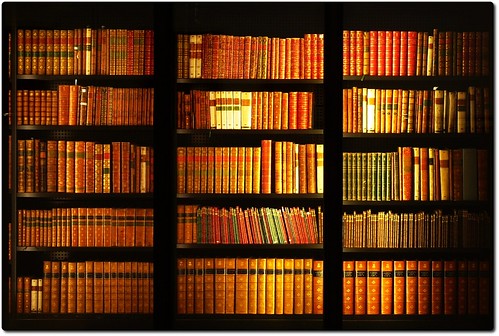
Over 65,000 books collected by the monarch George III have been moved into an imposing Tolkien-worthy six story black tower designed by Sir Colin St John Wilson who also designed the ruthlessly modern St Pancras location of the British Library in which the tower resides.


Exterior of the British Library
© The British Library Board

Designer, architect and fellow book lover Ashley Hicks who informed me of the new tower notes, "Part of the magic is theatrical, in that as you look at the tower, one of the bookcases will suddenly roll back within the cube and a librarian emerge and take a book from it – all behind glass, like a giant mechanical toy."

If you are so lucky as to have need to request some of the king's books for research, here are a few beautifully bound examples you might see. All bear the king's ownership mark, except the last which belonged to his consort, Queen Charlotte. The king took a great interest in bindings and opened an onsite bindery in 1780.


(All book images © The British Library Board.)

The history of the formation of the collection is worth a look-in. George III (ruled 1760-1820)was the third of the German Hanover clan to ascend the throne, and the first to be more English than German. He took it upon himself to transform the royal library into a universal one, and, under the steady hand of his advisor, Frederick Augusta Barnard, strategically purchased important classical literature, British and European history, English and Italian literature, and religious texts. A spectacular octagonal library was purpose built at the Queen's House (better known as Buckingham House).
The Octagonal Library
(from WH Pyne's The History of the Royal Residences... London, 1819)


Buckingham House known as The Queen's House
(from John Watkins' Memoirs of her most excellent Majesty Sophia-Charlotte, Queen of Great Britain ... London, 1819.)


Buckingham Palace post-George IV

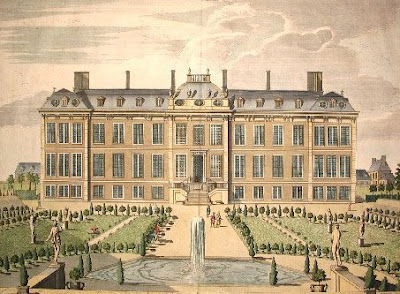
When the prolifigate George IV came to the throne and transformed Buckingham House into Buckingham Palace, the library was donated to the people in 1823 and installed at Montagu House, now part of the British Museum, where it stayed until 1998 and found it's present home at the BL.

Montagu House by James Simon, circa 1715


The King's Library at the BM
photo by Mujtaba Chohan

12 January 2009

Film Decor: Wife Vs. Secretary

One of my favorite silver screen residences is the Hollywood Regency house of Van and Linda Stanhope in the 1936 MGM Wife vs. Secretary.

The romantic comedy stars Clark Gable and Myrna Loy who are happily married until Myrna begins suspecting Clark of a liaison with his bodacious blonde secretary, Whitey, played by Jean Harlow. A young Jimmy Stewart is also in the film in a supporting role, but the real star as far as I am concerned is this house.

Lets take the tour....

The Entrance. The graphic use of dark and light and geometric designs on the floor and front door make the room pop. The flattening of ornament - such as the reeded column and the military trophy(what IS that?) painted on the wall is very Hollywood Regency.

The Living Room.


Helena Rubinstein would adore this dining room. Mirrored and dead white furniture make this tres a la mode - think Serge Roche. The towering taper candles and white marble statues - not your typical table setting - reinforce that the Stanhopes are a zippy, chic couple.


The hallway of the second floor.


The Bedroom. I want that bedspread. And isn't that "pinwheel" satin pillow on the tufted armchair great?


Linda's Dressing Room. As already mentioned here, this room was my first pick for the cover of RR.


Van's Dressing Room. (Don't you have his and hers dressing rooms?) The stripes and more butch furniture declare this is a man's room.

09 January 2009

McMillen: Nearing a Century of Style


When the Fricks and America's other bluebloods want to redecorate, they look no further than to the firm that has been refreshing their houses for generations: McMillen, Inc.


Established in the 1920s by Eleanor Stockstrom McMillen Brown, a Parsons graduate, McMillen, Inc. was a pioneer in the profession of interior decorating. Unlike many of her contemporaries, Mrs. Brown ran her practice as a business and didn't consider herself a society lady who "helped" friends with colors and curtains. She allied herself with one of her Parsons teachers, William Odom, whose refined eye and penchant for the neoclassical played no small part in her rooms that were notable for their timeless elegance, as seen below.


Mrs. Brown's Sutton Place Dining Room


Dining Room by Kelly Wearstler


McMillen's decorating services have been in demand through the decades, from the pool house for Standard Oil baron Colonel H.H. Rogers (father of Millicent who also used McMillen) in the 1930s to the private quarters of President Johnson in the 1960s. Mrs. Brown lived a vigorous 100 years, and came into her office everyday until the age of 90.

The latest work of Ann Pyne, a principal of McMillen, makes it clear that there is a lot more to come from the firm. This living room from a Sutton Place residence featured in the February issue of Architectural Digest is certainly traditional, but its restrained use of color and pattern make it "now".


Pyne's own New York residence is filled with an interesting mixture of family hand-me-downs and her collection of Aesthetic movement and Arts and Crafts pieces.


My favorite room is her study, where I could happily while away hours.


Her mother Betty Sherril is the president of McMillen, seen here in her grande dame-style living room.


I got a kick out of her very Hollywood dining room, with its silvered walls and leopard upholstery. The carpeting also has the same leopard print - meow!


Credits: Top and second photo from The World of McMillen by Erica Brown; #3 http://www.kellywearstler.com/; #4 by Durston Saylor for Architectural Digest; #5-#8 http://www.nysocialdiary.com/

06 January 2009

What Joan Would Do


It's that time of year when we are all setting resolutions and actually believing we will adhere to them and become creatures of perfection.

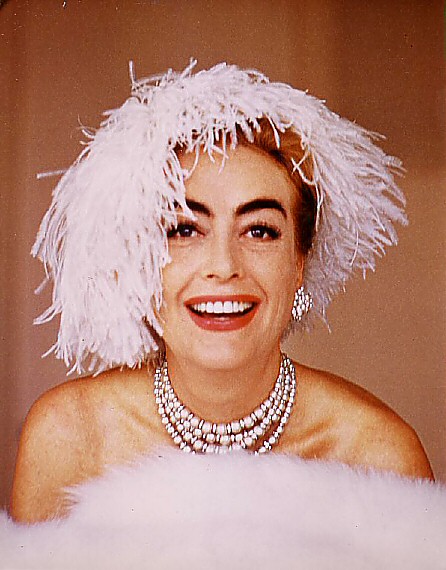
In this spirit, I thought I would offer a few words of wisdom on how to live well from the woman who taught me that wire hangers are just not on. Yes, that's right, Mommie dearest herself, Joan Crawford. You may even add a few new items to your list.


"That old saw, 'When in doubt, don't,' is never so true as when it comes to clothes. Or getting married." Joan knows of what she speaks, and shares many other pearls in the 1971 masterpiece
My Way of Life.

On how to accessorize:

"My rule: Don't buy a dress until you can afford all the right accessories and if, like me, you can't spend your life in hair curlers, have a hat made to match. I always get a yard and a half of extra of the fabric I've ordered for a new dress. Half a yard for gloves and a yard for a turban or breton."

On throwing a successful party:

"The best parties are a wild mixture. Take some corporation presidents, add a few lovely young actresses, a bearded painter, a professional jockey, your visiting friends from Brussels, a politician, a hairdresses, and a professor of physics, toss them all together, and try to get them to stop talking long enough to eat!"


On how to lose weight:

"At times I've deliberately gained weight. I did for
Mildred Pierce because I thought it suited the part....But the best condition I was ever in was when I was doing What Ever Happened to Baby Jane? in a wheel chair. I had to wheel myself around, push back and forth, turn quickly, and I was the thinnest I've been in years....(Get a wheel chair and try doing your housework in it!)"


On Packing:


"I always pack in daylight. In artificial light when I'm in a hurry it's too easy to grab the wrong accessories and find myself in Kansas City or San Juan with a hot pink dress and a shocking pink hat - and that's a catastrophe."


On Cleaning:


"I had no one to help me [clean] and I didn't want to spen two months making beds and scrubbing bathrooms. I called a neighbor who put his maid on the phone. 'I know someone for you,' she said. 'But I don't know whether you can put up with her. She's never heard of a bucket or mop.'

'Handsies, kneesies?' I asked.

'Yep,' she replied.
'Bring her over tomorrow morning. That's just my cup of tea. I never did think you could get into corners with any mop. '"


On regrets and being yourself:

"People are always asking me if there's anything I regret, or would change. The answer is no! Not a thing. If I hadn't had the pain I wouldn't be me. And I like being me. Everyone should. I have a friend who says 'Treasure yourself.'

"I follow that advice by doing a certain amount of self-pampering. I surround myself with happy colors - yellow, coral, hot pink, and Mediterranean blues and greens. I've persuaded myself that I hate things that are bad for me - fattening foods, late nights, and loud and aggressive people head the list. I'm friends with myself, so I do things that are good for me, otherwise I couldn't be good for others. I spend my time with people I'm fond of, and that includes my working time, too."


Photo credits: Top and bottom by by Eve Arnold - click here to read about Ms. Arnold's wild experiences photographing Joan; #2 by Joseph Griffiths, #3 Warner Bros. Publicity Photo, #4 from Whatever happened to Baby Jane?

04 January 2009

Fowler Pink?: The Kelmarsh Hall Conundrum


Interpreting an historical house is a fascinating process. Peeling back the layers and indeed deciding which layers to peel can be difficult and sometimes controversial.

Marianne Suhr, Surveyor of the Fabric at Kelmarsh Hall, wrote about a dilemma she and her colleagues recently faced in her paper "John Fowler and Nancy Lancaster at Kelmarsh Hall" published in John Fowler: The Invention of the Country House Style (Donhead, 2005).

Kelmarsh was designed by the important Palladian architect James Gibbs in the early eighteenth century in Northamptonshire. Architecture historian Nicolas Pevsner judged it“a perfect, extremely reticent design…done in an impeccable taste.”


However, Kelmarsh is best known as the house where Nancy Lancaster first established her taste in decorating. She and first husband Ronnie Tree came to the house in 1928 with the agreement to redecorate the Hall in lieu of paying rent. Upon arriving, the Trees found the Entrance Hall "a dark, rather sad green" which Nancy soon had painted over "an Italian pink, a light terracotta" which she copied from Lady Islington, "the person in England who had the very taste and the very best color sense." This pink, which became know locally as Kelmarsh pink, was much admired and copied by her neighbors. She complemented the pink with "two chairs covered in the most wonderful tangerine velvet, another in emerald green, one Queen Anne wing chair in bright yellow brocade and a chair and sofa in striped fabric I bought in Italy."

The current custodians of Kelmarsh realize the importance of Nancy Lancaster's contribution to 20th century decoration and decided to keep the Entrance Hall as a document of her early taste. However, the famous pink walls were flaking, which in fact had always proved to be a problem as the walls were originally of a burnished plaster mixed with marble dust and not meant to be painted. This condition meant that as soon as 1950 Nancy's pink walls needed to be refreshed. Enter John Fowler.


This is where things get sticky. In 1950, Nancy and 2nd husband Colonel Lancaster (the owner of Kelmarsh!) were divorcing, and furthermore she and Fowler were on the outs. Fowler who was entrusted with the project sent his color mixer Horace to work with a local firm, and came but once to inspect the project. According to a painter who was on the scene at the time, no effort was made to match the original pink.

Now that the walls are flaking again, do you take the color back to 1928 even if there's no guarantee that you can capture it but that is truer to the overall interpretation of the room, or do you conserve the Fowler pink and think of it as part of the room's history?

In the end, Kelmarsh decided to redecorate the lower half of the walls to 1950, and then to leave the paint above "with all its archeology."


What do you think?